Most people learn what a public adjuster is in the middle of a claim, not before one. The term comes up in a conversation with a contractor, or a neighbor mentions one, or it appears in a search after a settlement offer arrives that does not seem to match the damage.
This page explains the role in plain terms: what a public adjuster is licensed to do in Texas, what the day-to-day work actually involves, how the role differs from the other adjusters in a claim, and when it tends to be relevant.
The short definition
A public adjuster is a professional licensed by the State of Texas to represent a policyholder on that policyholder’s own property insurance claim.
The role is regulated under Chapter 4102 of the Texas Insurance Code. A license is required. Licensed adjusters carry a license number, file evidence of financial responsibility as a condition of licensure, and work under a written contract on a form approved by the state.
Two limits are worth knowing up front, because they define the boundaries of the role.
- A public adjuster does not practice law. Texas law expressly prohibits a public adjuster from engaging in the unauthorized practice of law in connection with a claim.
- A public adjuster cannot sign or endorse a payment draft or check on a policyholder’s behalf.
The three adjusters people confuse
Most confusion about the role comes from the word “adjuster” being used for three different jobs.
Works for the carrier
The carrier’s adjuster
Employed by the insurance company. They inspect the property, write the scope of damage, and prepare the estimate that the claim decision is built on. They are doing their job for their employer.
Works for the carrier
Independent adjuster
A contractor the insurance company hires when it needs additional capacity. Despite the name, they are retained by the carrier, not by the policyholder.
Works for you
Public adjuster
Retained by the policyholder. This is the only one of the three the property owner hires and directs.
That distinction is the whole reason the license category exists.
What the work actually involves
The role sounds adversarial in the abstract. In practice it is documentary and administrative. Most of it looks like this.
- 01
Reading the policy
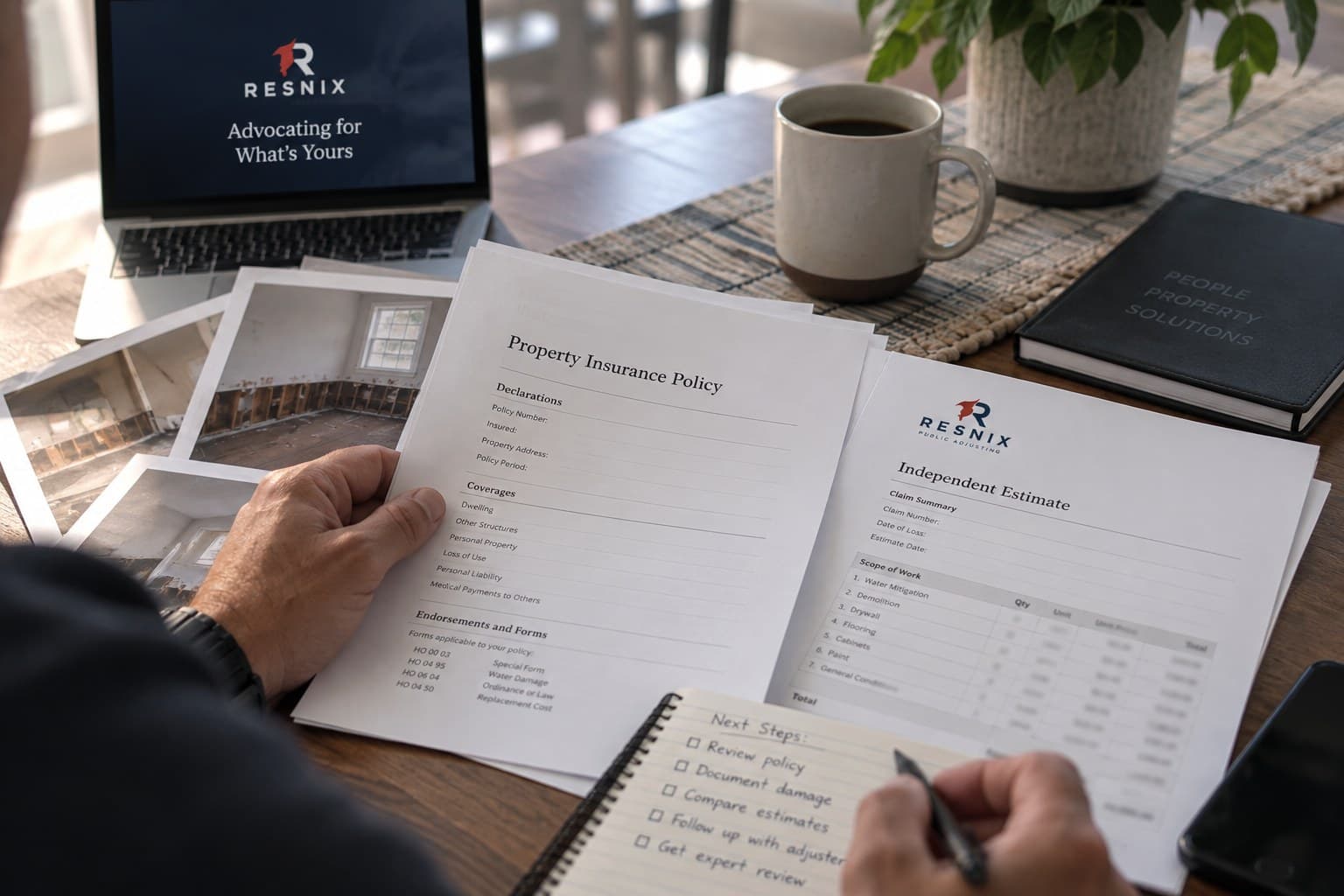
Before anything else, someone has to establish what the policy actually covers. That means the declarations page, the coverage forms, and the endorsements, which are the amendments that modify the base policy and often matter more than the base policy itself. Coverage for ordinance and law, water damage sublimits, cosmetic damage exclusions, roof payment schedules, and deductible structures all live in the endorsements.
- 02
Documenting the loss
Photographs, measurements, moisture readings where relevant, a room-by-room record, and an inventory of damaged contents. The goal is a record complete enough that someone who was not present can understand what happened and what it will take to repair.
- 03
Preparing an independent scope and estimate
A scope is a line-by-line description of the damage and the work required to address it. The carrier writes one. A public adjuster writes one as well, using the same estimating platforms and unit pricing the industry uses, so the two documents can be compared item by item rather than argued about in generalities.
- 04
Handling the correspondence
Claims generate a steady stream of requests for records, forms, statements, and clarifications, many of them with deadlines attached. Tracking what has been requested, what has been provided, and what remains outstanding is a meaningful part of the work, particularly on a claim that runs for months.
- 05
Managing the policy’s requirements
Property policies contain a section commonly titled Duties After Loss. It sets out what the policyholder is responsible for once a claim is open: prompt notice, protecting the property from further damage, inventories, receipts, access for inspection, records on request, and in many policies a sworn proof of loss within a stated period. These obligations are easy to miss when you are also arranging repairs and finding somewhere to sleep.
- 06
Reviewing what has been offered
When an estimate or a settlement offer comes in, the review works backward from the number to the scope it was built from. What rooms were included. What materials were specified. What was measured and what was assumed. What was addressed and what was not.
When the role is relevant
Not every claim needs a public adjuster. A straightforward claim, handled promptly and paid in line with the damage, does not require a third party.
The role tends to become relevant when a claim is complex or has stalled:
- A large loss involving structure, contents, and additional living expenses running at the same time
- A fire claim, where the contents inventory alone can take weeks
- A water damage claim where the cause of loss determines coverage
- A scope that does not appear to match the visible damage
- A claim that has been denied, partially denied, or has gone quiet
- Commercial property, where business interruption and code upgrade issues add layers
- A property owner who does not have the time or the stomach to manage the file themselves
How public adjusters are paid in Texas
The statute also carves out a specific situation: if the insurer pays or commits in writing to pay the policy limit within 72 hours of the loss being reported, the adjuster may not take a percentage commission on that claim and is instead entitled to reasonable compensation based on time spent and expenses.
Whatever the arrangement, it has to be in a written contract on a state-approved form before work begins. Read it before you sign it.
Questions worth asking before you hire one
- 1What is your Texas public adjuster license number?
- 2What is the fee, how is it calculated, and what is it calculated on?
- 3Who will handle my file day to day?
- 4How will you keep me informed, and how often?
- 5What happens if I want to end the agreement?
- 6Have you handled claims of this type and size before?
Any licensed adjuster should be able to answer all six without hesitation.
Frequently asked questions
- Is a public adjuster the same as an insurance adjuster?
- No. The carrier’s adjuster and independent adjusters are retained by the insurance company. A public adjuster is retained by the policyholder and is licensed separately by the state.
- Do I need a public adjuster for every claim?
- No. Many claims are handled without one. The role tends to matter on larger or more complicated losses, and on claims that have been denied, partially paid, or delayed.
- Is a public adjuster a lawyer?
- No. Public adjusters handle the adjustment of a claim. Texas law prohibits them from engaging in the unauthorized practice of law.
- How much does a public adjuster cost in Texas?
- Fees are set by written contract and are capped by statute. Section 4102.104 of the Texas Insurance Code limits the total commission to 10 percent of the insurance settlement on the claim.
- Can I hire a public adjuster after my claim was denied?
- Yes. A denial is a written position taken on a given date based on the information in the file at that time. It can be reviewed.
- Can a public adjuster sign my claim check?
- No. Texas law prohibits a public adjuster from signing or endorsing a payment draft or check on behalf of an insured, regardless of any authorization given.
This article describes general provisions of the Texas Insurance Code and is not legal advice.
Resnix Public Adjusting
Licensed Texas public adjusting firm · Serving DFW Texas · Texas Public Adjuster License No: 2946133